![[logo]-AET](/templates/common/images/template/aet-logo-top.png)
![[icon]](/templates/common/images/icons/search-icon.png) Search
Search


One of the early questions to consider as a new educational therapist is “What kind of practice is best for me?” There are several different ways to practice educational therapy including school based, private practice, and service organization-based practice. In this section, each way of working is introduced.
Although these types of practice are listed separately, many ETs operate in a “hybrid” practice in which they work part-time in one type and part-time in another. For example, an ET may be a learning specialist providing school-based services and have a private practice. An important challenge when working in a hybrid model is how to manage the balance of time required for your contract with the time required for your private practice. For more on maintaining balance in your work see the Health and Wellbeing portion of the website.
-
Private Practice
-
As a private practitioner, you have the highest level of independence and flexibility, but you are responsible for all of the administration and office work. A private practitioner decides on the type of students to support, the therapeutic methods to use, the materials to use, where and when to offer services, and what to charge for services. The private practitioner is also responsible for marketing the practice, finding clients, all documentation from intake through completion, business matters including business licenses, rent, billing, collections, tax reporting, tax payment, and everything else.
Private practices can take many forms. Some ETs work as sole proprietorships with no employees or independent contractors. In essence, that is a one-person business. Some private practices have multiple employees and/or partners. Finally, some private practices offer work on an independent contract basis. Some practice at home, some have rented office space, some travel to the homes of their clients, and others meet in a neutral space (e.g., library, coffee shop) or online.
There are requirements for an employer that are different from those for independent contractors working for you. If you have employees, you will need to provide clear policies and procedures and supervision for your employees. There are payroll and reporting requirements as well. A lawyer and accountant should be consulted to understand what is required of an employer before you hire your first employee.
Independent contractors are hired by establishing a contract for services. The contract establishes the relationship, business, and work expectations between the independent contractor and you. Generally, independent contractors are paid as a business expense without withholding requirements, but there are specific rules and reporting requirements for independent contractors. A lawyer and accountant should be consulted before you hire independent contractors. They can help you with developing a contract that contains all the necessary wording and provides guidance on how you will capture information and meet reporting requirements.
Some educational therapists are hired by schools. Typically, the student’s IEP specifies the educational therapy, the school districts fund payment, and the ET is hired as an independent contractor.
-
How Are Employees and Contractors Different?
-
Employees work directly for the company that hires them. They are paid either hourly or by salary to do a specific job. The employee is expected to comply with all company policies, procedures, and reporting requirements. They may be required to report their time on a particular schedule or punch a timecard. Employers are required to pay their employees on a stated schedule. They pay taxes for each employee and withhold taxes on behalf of the employee. Employers may offer benefits for their employees such as insurance, investment opportunities such as 401K plans, matching funds for education or charitable donations, training offerings, etc. Many employers use a payroll service to handle reporting and payment to employees.
Contractors are independent business owners who sign a contract with a company to provide a specific service for an agreed fee. The contract describes the services to be provided, standards and reporting requirements, method of supervision, requirements for reporting and billing for services and expenses, conditions under which the contract may be terminated, and more. The independent contractor is paid for a bill submitted with documentation. Independent contractors are not eligible for company benefits and must provide their own health, errors and omissions insurance, and other benefits an employer may make available to employees. In the US, companies are required to report payments to independent contractors to the taxing authorities, and they also must provide a record to the independent contractor. The independent contractor is required to report all income from their contracts, and they must submit the tax record (W-9) from each company with whom they contracted.
An independent contractor has more independence in managing their time and work schedule than an employee. Most states have criteria that must be met to qualify as an independent contractor. For example, in California, an independent contractor must have more than one client and must be able to establish their own schedule. Since an independent contractor works independently of the companies they contract with, they are responsible for accounting for their earnings and expenses including withholding taxes. The tradeoff is that independent contractors have more independence, but they have to do more on their own in terms of marketing, training, and accounting. Independent contractors need to think through how they will build this additional overhead into the price they quote in the contract.
-
School Based Services
-
In most states, a teaching, counseling, or other license is required to work in the public schools. Private schools have more flexibility, and many private schools now have full and/or part time learning specialists. When working in a school-based setting, you have less flexibility concerning the levels of support you can offer, your schedule, and location of services. The school policies will define how often you see students, what methods and materials you use, and when to refer out to other professionals. What you give up in independence, you gain in two ways. You will not have to market yourself to find students to serve, and most administrative tasks (e.g., marketing, accounting) will be reduced or eliminated. You are still responsible for intake, on-going, and exit documentation, but billing and collections are not your responsibility. When working in a school, your income may be more stable but may be lower than you could make if you were in a private practice. Most schools will offer health insurance, flexible savings accounts, and other benefits for full time employees and may offer some benefits for part-time employees who work more than a set number of hours.
-
Service Organization Work
-
Some service organizations hire educational therapists either full or part time to work with clients. For example, in Minnesota, the Learning Disabilities Association offers tutoring and educational support services. Some of these organizations hire ET’s as contractors paid by the number of clients served, and some hire the ET outright. In some states, Americorps has in-school and after school tutoring services that can be full or part time. When working with service organizations, the pay tends to be lower, but it comes with the benefit of serving high need students who may not be able to afford educational therapy otherwise.
-
Hybrid Models
-
There are several hybrid models in which educational therapists work part-time in a school or service organization and part-time in private practice. The key is to find the balance that will work for you. Some questions to consider in making this decision:
- How much autonomy do I want to have, and what am I willing to do to maintain it?
- Am I the kind of person who works best on my own or as part of a team?
- How confident am I in my ability to market and get my name out there as a practitioner?
- How confident am I in my ability to bill, collect, and track payment?
- How will I balance my time between my obligations to the school and my private practice?
- If I work in a private school or other organization, how will I handle the politics of academia?
- How much do I have to invest in setting up a practice at the outset?
- What resources do I have available to me to help me get started?
- How will I handle health insurance?
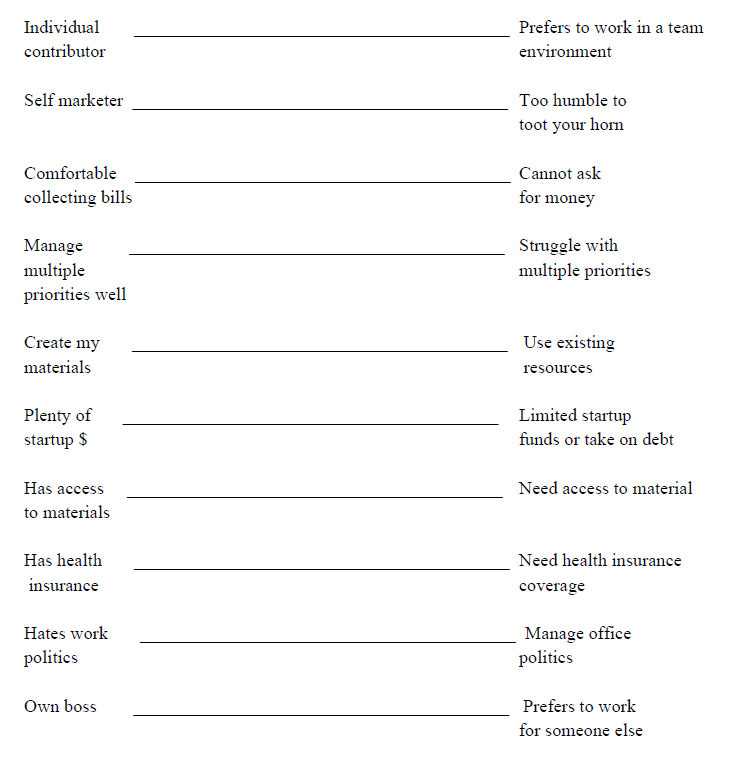
A Tool to Organize Your Thoughts
The graphic organizer below is designed to help you understand where you see yourself on the continuum suggested by each question. Place a mark at the point along the continuum where you see yourself. As you fill it out, be as clear as you can about your preferences. There are no right or wrong answers, but the alignment that describes you, your preferences and resources may suggest which way of working could be most satisfying for you.
![[banner]-conference 2025](/images/promotions/promotion-26-conference.jpg)
![[sponsor logo]](/images/conference/sponsor-logos/APA-thumb.jpg)
![[sponsor logo]](/images/conference/sponsor-logos/NotreDame.jpg)
![[sponsor logo]](/images/conference/sponsor-logos/ucsc-logo.jpg)
![[sponsor logo]](/images/conference/sponsor-logos/Kiwi-Write.jpg)
![[sponsor logo]](/images/conference/sponsor-logos/McLean.jpg)
![[sponsor logo]](/images/conference/sponsor-logos/Havit-thumb.jpg)
![[sponsor logo]](/images/conference/sponsor-logos/Winsten-Prep-School.jpg)
![[sponsor logo]](/images/conference/sponsor-logos/AnnKaganoff-thumb.jpg)