![[logo]-AET](/templates/common/images/template/aet-logo-top.png)
![[icon]](/templates/common/images/icons/search-icon.png) Search
Search


One of the tricky parts of business planning is determining how many hours of services you have to offer. If you were selling a product, the limit of how much you can sell would be determined by the availability of the product from the manufacturer. When your product is time, it is challenging to determine how much you have that is marketable. If you work a part time job outside of your practice, those hours are not available. If you have family, you need time for them and for yourself. For every hour you spend with a student, you need preparation, follow up, and reflection time. You also need time to manage your business, do billing and receiving, marketing, training, etc.
-
When Are Clients Available?
-
The number of hours that you have available to serve clients then must be matched up with the days and times that clients are available.
- Students in grades K-12 usually are not available between 8:00 AM and 3:30 PM or a similar schedule with a slightly different start and end time. Many students are tired and need a break before seeing an ET or get progressively more tired as the evening wears on, so they need to see the ET on the early side. Many students are so tired by the end of the week that they need Friday afternoons off. Weekends are often considered family time. Students who participate in travel sports may not have a consistent day or time that they are available on weekends.
- Adults need to build their ET needs around work, child care, and other commitments. Some adults prefer early sessions before work, and others prefer evening sessions so they can go home afterwards. Adults often are in charge of bringing the child to sessions (for in person sessions), so commute time and traffic patterns can be helpful to consider.
- Summer schedules are likely to be impacted by travel plans, camps, summer school, and changing schedules for both you and the client. The schedule you worked out for September through June may be completely different than the one you have for the summer.
The number of weeks per year you plan on working with students is another time question to consider. For students, most schools are open approximately 30 weeks per year. Some schools (called year round schools) are open longer. Consider time away that you need for family plans including vacation, holidays, family events that require travel as well as work travel for training, meetings, and conferences.
-
Hours Available Analysis Tool
-
The Hours Available spreadsheet can help you develop your understanding of how many hours you really have available to see students. Use this spreadsheet to capture how many hours per week you are able to work, which hours you and your target clients are available for ET, how much time you need to set aside for non-client work, and calculate the number of hours available that implies.
This tool is based on weekly hours. You may choose to have more than one sheet on your personal document, one for your primary schedule (e.g, school year), and one for the summer schedule.
Starting a private practice can be exciting and lead to satisfying work that pays well, serves others, and is enjoyable. Take time up front to define your practice and plan out your business. As you plan your practice, you will consider what services you will offer, what clients you will serve, what materials you need to have, what training you need to seek out, where to offer services (in person/online/hybrid), how much to charge, how to handle the accounting, how to market yourself, and more.
This section discusses key elements to consider as you define your practice. At the end, there is an example of the practice plan developed by one educational therapist. Yours will look different, but it is meant to give you an idea of a practice definition that is complete.
-
Areas of Interest and Skill*
-
- What trainings have I completed?
- What areas do I enjoy most?
- What do I do most successfully?
- What materials do I have?
- What do I want to add to my skill set?
*The AET Code of Ethics section on representation states that Educational Therapists:
- accurately represent in an ethical and legal manner their competence, education, training, and experience.
- provide professional services only within the boundaries of their competence based on their education, training, supervised and professional experience while operating within the scope of practice and ethics of the Association of Educational Therapy. Those engaged in e-practice operate within the scope of practice and ethics of the Association of Educational Therapists, as when providing services to clients in-person.
- claim as evidence of professional qualifications, in accord with the requirements described in the Bylaws of the Association of Educational Therapists, only those transcripts, documents, and training experiences which they have duly earned.
- adhere to the Association of Educational Therapist’s ethical guidelines as well as all applicable laws of the state(s) in which they practice when deciding which services they are qualified to provide.
- follow specialized standards when engaged in e-practice.
-
Clients I Want to Serve
-
- age range
- area of need
- frequency and duration of sessions
- distance I am willing to travel
- hours I can work
- proportion of in-person to online
- reduced rate hours I can offer (if any)
-
Possible Location for In-Person Services
-
- school
- my home
- my office
- client’s home
- neutral site (e.g., library, park, coffee shop)
-
Online Considerations*
-
- my location when I am online
- my technology (e.g., Zoom, document camera, online apps, tools, internet quality, audio quality)
- client’s technology needs
- client’s location and environment
- client’s physical equipment needs (e.g., white board and markers, workbooks, physical books, manipulatives, etc)
- client supervision if needed
- privacy and confidentiality
* The AET Code of Ethics has specific considerations for engaging in e-practices. E-practice is defined as services using telecommunication technologies which include the preparation, transmission, communication, or related processing of information (writing, images, sounds, or other data) by electrical, electromagnetic, electromechanical, electro-optical, or electronic means.
Telecommunication technologies include but are not limited to telephone, mobile devices, interactive videoconferencing, e-mail, chat, text, and Internet (e.g., self-help websites, blogs, and social media). Services may be synchronous or asynchronous (e.g., e-mail, online bulletin boards, storing and forwarding of information). Technologies may augment traditional in-person services or be used as a standalone service model.
-
Services I Will Provide
-
- one to one
- groups (maximum number of students)
- age range
- skill level
- types of service for example,
- assessment
- literacy–phonological awareness, decoding, encoding, comprehension, fluency
- writing–handwriting, keyboarding, voice to text, content writing
- math–number sense, procedures, problem solving to what level
- self advocacy–understanding your needs, speaking up to get the best result
- executive functioning–metacognition, organization, initiation and follow through, planning and prioritizing, flexing and adjusting, memory and attention, etc.
- English language learning
- gifted/twice-exceptional needs
- parent education and support
- school education and support
-
Programs and Methods I Use For:
-
- reading
- writing
- math
- executive function
- English language support
- gifted/twice-exceptional
- parents
- schools
-
Determining What to Charge
-
There are many factors that go into the decision of what rates to charge. First, it is important to consider your income needs and the clients you wish to serve. Next, you must determine what rates the market in your area will support. While educational therapists may not agree among themselves to establish a rate they will charge (that is called collusion and it is illegal), performing a selection of informational interviews and sampling the fees of educational therapists in your area may be helpful to gauge the range of rates others charge. Rates for services will vary considerably based on specific geographical location, areas of academic expertise, types of training, and years of experience. Some ETs also provide pro-bono services and sliding scales to enable a wide range of families to have access to ET services. Additional fees may be charged for such services as school visits, attendance at IEP meetings, travel to a client’s home, materials, report writing, and ongoing consultation with the parent/caregiver. These fees should be specified in advance as well as the policy for cancellation.
For more information about setting rates see these links:
How to set Rates
Rate Analysis Sheet
Hours Analysis
Hours Available Analysis Sheet
Reduced Rate Services
Reduced Rate Analysis Sheet
-
What to Include in Standard Rates and What Is Extra?
-
Each educational therapist must decide what will be included in the standard rate and what will be billed separately. This should be clearly spelled out to the client. When you decide on your rates, be sure to consider each of these.
- Are these included in the session rate or extra?
- preparation and notes
- non-consumable materials–manipulatives, readers, etc.
- consumable materials–workbooks the student writes in and keeps
- communication with schools
- communication with parents/caregivers
- written reports
- assessment time
- assessment reports
- meetings with school–IEP meetings, teacher meetings
- allied professional communication and meetings
- What is the charge for each item that is not included in the session rate?
- What are the cancellation policies, will you charge the full rate or some other amount?
- What are the conditions and charges for late fees?
- Are these included in the session rate or extra?
-
Session Packaging
-
There are several ways that different educational therapists package or charge for their services. The ones listed below give an idea of some of the many options. It is unlikely that any one ET would use all of these, yet they are worth considering as you decide what works for you.
- straight charge by the hour
- charge by the hour with discount for multiple sessions per week
- charge a single rate for a set number of sessions, e.g, $750 for a block of 8 sessions.
- charge a different rate if the client wants more included, e.g., a written summary after each session vs. quarterly written updates
- discounts for referrals, e.g., $50 off of a session for a referral that becomes a client
- additional charge for services provided between sessions, e.g., daily text to a student who needs reminders to support executive functioning challenges.
SAMPLE of One Solo Practitioner’s Practice Plan
Areas of Interest and Skill:
Training/expertise:
- Reading:
- Orton Gillingham Wilson Intervention, Fundations, Just Words,
- IMSE Comprehensive, Intermediate
- Lindamood-Bell Seeing Stars, Visualize and Verbalize, LAC administration
- Peter Bowers Structured Word Inquiry
- Math:
- Making Math Real Institute through Pre-Algebra
- Math U See methodology
- Americorps K-3 math methodology
- Writing:
- Writing Revolution
- Diana Handsbury King
- Handwriting Without Tears
- Self Regulation:
- Zones of Regulation
- Social Thinking—Michelle Garcia Winner
- Ross Greene–Lost at School methods
- Executive Functioning:
- Workshops by Sarah Ward, George McCloskey,
- Dawson and Guare
Students and Areas of Struggle I Support Well:
K-3 reading and math development
Upper elementary and middle school–Reading comprehension, writing development, and number sense remediation to strength math thinking
Middle school and high school—Study strategies, planning and organization skills to “do school” well. Executive functioning coaching.
Students with nonverbal learning disorder, dyslexia, dyscalculia, and resulting struggles
Clients I Want to Serve:
Elementary and middle school. I will support current students as they move into high school, but will not start out with students in high school.
I would like to work on a mix of approximately 50% hours early elementary and 50% hours upper elementary and middle school.
20% of hours will be offered at a reduced rate to reach out to underserved students.
I prefer to have 100% in person services, but will provide e-service for up to 20% if needed. Also will consider using e-service in snow or other emergency situations in which it would be difficult to access the in-person location.
Location of Services:
I prefer to serve students at school or in my home. I can also serve them at a neutral location like a community center or library. I do not serve students in their home–boundary and attentional difficulties. When online, I will be at home in my office with the door closed–best security and privacy for student. I will use Zoom, my laptop, and a document camera. The student must be at their home with a parent or caregiver available. The student will be asked to have a small whiteboard and marker with them. In some cases, the student will be asked to have manipulatives or workbooks.
Services I Will Address:
- Educational assessment to identify appropriate starting point and baseline.
- Literacy support K-8
- Math support K-6
- Self Regulation K-8
- Self Advocacy 5-8
- Executive Functioning 5-12
- Parent support
- School/Teacher support
Hourly Rates and What Is Included:
Standard session rate: $xxx per session for 50 minute session with 10 minutes for prep, put away, and quick check-in with caregiver.
Charges Separate From Hourly Rate:
- Phone calls to parent—no charge for the first 15 minutes. Then $xx per 15 minutes after that
- Phone calls with school–no charge—if it helps the school, it is worth it.
- Phone calls with other professionals–$xx per 15 minutes
- Consumables will be billed separately.
- Written status report quarterly—included in hourly fee.
- Reports for IEP meetings—separate–$ yyy per report
- IEP meeting participation–$zzz for each time the team meets.
- Assessments—$www per session with student,
$vvv per assessment report
Session Packages
- Standard rate per session is $xxx.
- Reduce to $xxy for 3 or more sessions per week
- $xx credit for referral that becomes a regular client
- Rate reduction to $xxz if a block of 8 sessions is paid in advance.
- For reduced rate clients—reduction percentage is applied to multiple sessions or blocks paid in advance.
Other Policies:
- No charge for cancellations due to illness within 24 hours
- No charge for cancellations more than 24 hours in advance.
- No show no call fee $xx or ½ session for reduced rate students
- 3 No Shows may result in termination of service.
- Sessions suspended if the bill is not paid within 30 days.
- Sessions are terminated if the bill is not paid within 60 days.
- Consent forms required (Code of Ethics):
- Share information with anyone other than parent/caregivers including stepparents, grandparents, non-custodial relatives.
- Release the student to anyone other than parent/caregivers including stepparents, grandparents, non-custodial relatives.
- Release to use photograph or voice or samples of student work in non-student related ways (e.g., on website or in publications)
- Consent to work with the student by all custodial people–parents, caregivers, social workers. If the parents are separated or divorced, consent must be obtained from both parents unless otherwise ordered by a court.
- Consent to use email and other electronic means of communication
- Acknowledgment that I report all instances of potential child abuse or neglect to authorities
- Fragrance free office
There are several ways to organize a private practice. This section describes the most common types for educational therapy and offers some considerations in deciding on what works best for you. Since there are different options and rules depending on the city, state, or country you are in, please recognize that this is only a list of common types, not all types. As you consider the type of business structures, AET recommends that you consult an accountant and/or attorney to understand the reporting and tax implications of your decision.
-
For-Profit/Non-Profit
-
One critical decision is whether you are going to be a for-profit or non-profit organization. A for-profit organization is organized for the purpose of making a profit. A non-profit organization is organized to provide services or work that will benefit the public. A non-profit can collect donations and earn revenues, but any profit must be invested back into the organization or donated out to benefit the public. In a non-profit, the educational therapist typically will be an employee paid out of the earnings.
-
Types of For-Profit Business
-
Once you decide on a for-profit business, there are several different ways to organize your business. They include sole proprietor, S-corporation, limited liability corporation, and more. The website link below describes the different types of business structures available and some considerations in choosing one over the others. Some states have restrictions on who can be in some types of business. For example, in some states only licensed professionals can be organized in a professional organization. In this example, an educational therapist cannot be an owner in a professional corporation unless they hold a license in another field such as psychology or speech and language pathology. This website offers a brief summary of business types for you to review.
There are costs, requirements, and benefits to each type of business, and what is right for you will depend on your financial circumstances, other income your family may have, your risk tolerance, what state you live in, and your tax situation. It is important to know that your initial decision is not carved in stone. If you start out as a sole proprietorship and your business grows to the point that you need a different structure, you can change it. When deciding on the type of business you will start, it is imperative that you consult a professional accountant and/or attorney to receive the most pertinent information as it relates to your country, state, and/or city.
-
Business License Requirements
-
Many countries, states, and cities require a general business license, and many cities require a business license in order to do business within the city footprint. The cost of the license will vary depending on your city, state, and country. You need to determine what sort of business license is required before you begin to operate. If a license is required, be sure to allow adequate time to apply for and receive it before beginning to see clients.
One of the early questions to consider as a new educational therapist is “What kind of practice is best for me?” There are several different ways to practice educational therapy including school based, private practice, and service organization-based practice. In this section, each way of working is introduced.
Although these types of practice are listed separately, many ETs operate in a “hybrid” practice in which they work part-time in one type and part-time in another. For example, an ET may be a learning specialist providing school-based services and have a private practice. An important challenge when working in a hybrid model is how to manage the balance of time required for your contract with the time required for your private practice. For more on maintaining balance in your work see the Health and Wellbeing portion of the website.
-
Private Practice
-
As a private practitioner, you have the highest level of independence and flexibility, but you are responsible for all of the administration and office work. A private practitioner decides on the type of students to support, the therapeutic methods to use, the materials to use, where and when to offer services, and what to charge for services. The private practitioner is also responsible for marketing the practice, finding clients, all documentation from intake through completion, business matters including business licenses, rent, billing, collections, tax reporting, tax payment, and everything else.
Private practices can take many forms. Some ETs work as sole proprietorships with no employees or independent contractors. In essence, that is a one-person business. Some private practices have multiple employees and/or partners. Finally, some private practices offer work on an independent contract basis. Some practice at home, some have rented office space, some travel to the homes of their clients, and others meet in a neutral space (e.g., library, coffee shop) or online.
There are requirements for an employer that are different from those for independent contractors working for you. If you have employees, you will need to provide clear policies and procedures and supervision for your employees. There are payroll and reporting requirements as well. A lawyer and accountant should be consulted to understand what is required of an employer before you hire your first employee.
Independent contractors are hired by establishing a contract for services. The contract establishes the relationship, business, and work expectations between the independent contractor and you. Generally, independent contractors are paid as a business expense without withholding requirements, but there are specific rules and reporting requirements for independent contractors. A lawyer and accountant should be consulted before you hire independent contractors. They can help you with developing a contract that contains all the necessary wording and provides guidance on how you will capture information and meet reporting requirements.
Some educational therapists are hired by schools. Typically, the student’s IEP specifies the educational therapy, the school districts fund payment, and the ET is hired as an independent contractor.
-
How Are Employees and Contractors Different?
-
Employees work directly for the company that hires them. They are paid either hourly or by salary to do a specific job. The employee is expected to comply with all company policies, procedures, and reporting requirements. They may be required to report their time on a particular schedule or punch a timecard. Employers are required to pay their employees on a stated schedule. They pay taxes for each employee and withhold taxes on behalf of the employee. Employers may offer benefits for their employees such as insurance, investment opportunities such as 401K plans, matching funds for education or charitable donations, training offerings, etc. Many employers use a payroll service to handle reporting and payment to employees.
Contractors are independent business owners who sign a contract with a company to provide a specific service for an agreed fee. The contract describes the services to be provided, standards and reporting requirements, method of supervision, requirements for reporting and billing for services and expenses, conditions under which the contract may be terminated, and more. The independent contractor is paid for a bill submitted with documentation. Independent contractors are not eligible for company benefits and must provide their own health, errors and omissions insurance, and other benefits an employer may make available to employees. In the US, companies are required to report payments to independent contractors to the taxing authorities, and they also must provide a record to the independent contractor. The independent contractor is required to report all income from their contracts, and they must submit the tax record (W-9) from each company with whom they contracted.
An independent contractor has more independence in managing their time and work schedule than an employee. Most states have criteria that must be met to qualify as an independent contractor. For example, in California, an independent contractor must have more than one client and must be able to establish their own schedule. Since an independent contractor works independently of the companies they contract with, they are responsible for accounting for their earnings and expenses including withholding taxes. The tradeoff is that independent contractors have more independence, but they have to do more on their own in terms of marketing, training, and accounting. Independent contractors need to think through how they will build this additional overhead into the price they quote in the contract.
-
School Based Services
-
In most states, a teaching, counseling, or other license is required to work in the public schools. Private schools have more flexibility, and many private schools now have full and/or part time learning specialists. When working in a school-based setting, you have less flexibility concerning the levels of support you can offer, your schedule, and location of services. The school policies will define how often you see students, what methods and materials you use, and when to refer out to other professionals. What you give up in independence, you gain in two ways. You will not have to market yourself to find students to serve, and most administrative tasks (e.g., marketing, accounting) will be reduced or eliminated. You are still responsible for intake, on-going, and exit documentation, but billing and collections are not your responsibility. When working in a school, your income may be more stable but may be lower than you could make if you were in a private practice. Most schools will offer health insurance, flexible savings accounts, and other benefits for full time employees and may offer some benefits for part-time employees who work more than a set number of hours.
-
Service Organization Work
-
Some service organizations hire educational therapists either full or part time to work with clients. For example, in Minnesota, the Learning Disabilities Association offers tutoring and educational support services. Some of these organizations hire ET’s as contractors paid by the number of clients served, and some hire the ET outright. In some states, Americorps has in-school and after school tutoring services that can be full or part time. When working with service organizations, the pay tends to be lower, but it comes with the benefit of serving high need students who may not be able to afford educational therapy otherwise.
-
Hybrid Models
-
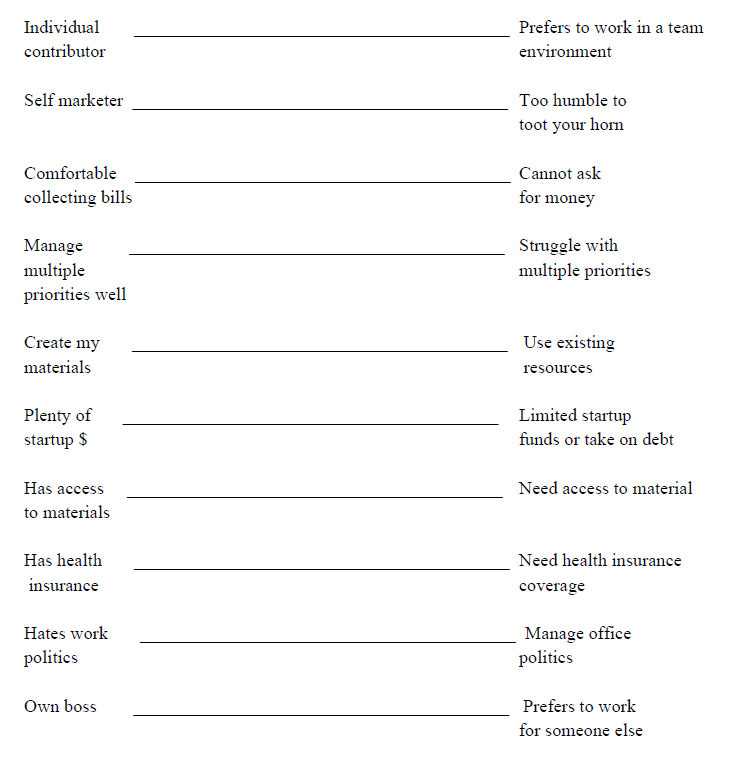
There are several hybrid models in which educational therapists work part-time in a school or service organization and part-time in private practice. The key is to find the balance that will work for you. Some questions to consider in making this decision:
- How much autonomy do I want to have, and what am I willing to do to maintain it?
- Am I the kind of person who works best on my own or as part of a team?
- How confident am I in my ability to market and get my name out there as a practitioner?
- How confident am I in my ability to bill, collect, and track payment?
- How will I balance my time between my obligations to the school and my private practice?
- If I work in a private school or other organization, how will I handle the politics of academia?
- How much do I have to invest in setting up a practice at the outset?
- What resources do I have available to me to help me get started?
- How will I handle health insurance?
A Tool to Organize Your Thoughts
The graphic organizer below is designed to help you understand where you see yourself on the continuum suggested by each question. Place a mark at the point along the continuum where you see yourself. As you fill it out, be as clear as you can about your preferences. There are no right or wrong answers, but the alignment that describes you, your preferences and resources may suggest which way of working could be most satisfying for you.
The start of private practice will require a sizable investment into materials for students. It is important to think through both the needs of your students as well as tools the educational therapist will need to implement when working with the client. It is important to be selective but ensure you have the proper tools. It is easy to overspend, especially when you first begin. Think about the budget and specialization of your practice, both by grade level and content. Younger students typically do better with hands-on materials when learning new tasks while older students may require technology and digital materials.
A good place to start is to think of classroom materials needed for the various grade levels to help anticipate what may be needed. If you plan to see clients virtually, your materials will all need to accommodate that presentation mode. If you are seeing clients in person, a variety of school supplies should be readily available such as pencils, pens, highlighters, markers, ruler, protractor, scissors, stapler, hole puncher, binder rings, stapler, paper clips, etc. A white board and markers can be very useful and can save on consumable paper materials. A color printer is helpful for printing resources as well as for older students to print finished work. If seeing clients in person, furniture and décor for the space may be needed and should be included in the start-up budget. If you choose to work virtually, a budget for furniture and decor may be replaced by docu-cameras or other tools to support online instruction.
Outside of classroom/office supplies and furniture, the other resources will be dictated by the specialty of the ET. If you plan to specialize in literacy, your materials will differ than if you chose to focus on math. Most ET’s who work with literacy skills require reference materials such as dictionaries, encyclopedias, and atlases. Many of these can now be found online; however, it would be valuable to have a selection of favorite resource sites bookmarked on the computer to ensure quick and easy implementation during a session. This is a good practice when first starting as well as a good lesson to teach a student. Some ETs prefer to have paper copies of these reference materials for use in sessions.
Depending on the age level of the students you plan to see, a personal library of fiction, non-fiction, and poetry books at different reading levels will be required. A good selection of topics and reading levels is essential, from picture books, decodables (books written to give practice decoding specific word types like silent-e words or vowel team words), chapter books, graphic novels, Newberry winners to the classics. It is best to become familiar with the books that are typically assigned by the local school district or the individual schools. Many middle and high school students use online textbooks and are provided Chromebooks or laptops to access school materials. As a result, it is not essential to have a library of textbooks for the upper grade levels. There are sites such as STUDY.COM and LitCharts that require annual subscriptions but can cut down on the amount of material to have physically on hand. Mathematics will require resources and games that align with the content being covered in school by your clients or by the area of focus. There are numerous sites–some free and some requiring subscriptions–that can provide additional practice and strategies to assist in all areas of mathematics.
There are numerous choices for instructional materials and new materials are continuously coming on the market. Be thoughtful in your choices. Storage (either physical and/or virtual) and cost are two important factors to consider. If interested in a packaged program, spend time researching the various components to evaluate the use and how it could apply in your practice. Become familiar with the well-recognized companies who provide high quality educational materials such as EPS, Curriculum Associates, and LinguiSystems. Many companies offer training that accompany products, and some, such as Making Math Real, Wilson, and Lindamood-Bell, require training and/or particular credentials to purchase and implement materials with students.
Depending on the age and focus of your practice, many educational therapists purchase educational games and activities. Amazon, Lakeshore Learning, Learning Resources, School Specialty, and Hand to Mind have numerous resources to choose from. ThinkFun, Gamewright, and Learning Resources generate popular and educational games. Look for the award winners–voted popular by parents and teachers.
Gradually your library of materials will grow as it continues to align with the changing needs of the clients within your practice. Webinars, study groups, or social media can be helpful to identify new and creative materials for your clients. Quality of material is far more valuable than quantity. The table below lists types of materials to consider. Remember that you don’t have to buy everything in your first year of practice. Some materials are updated regularly, so you will have the most current materials if you get them as you are going to begin using them.
Practice Materials Table
Materials that are needed for your practice will vary among the types of practice, age group, and current financial situation. One way to approach this topic, is to divide it between supplies for the educational therapist and supplies for the students. Supplies for the therapist will include school supplies as well as professional development tools such as books, webinars, and courses. Materials for the student will need to vary to fit the group of students you are working with. Entire programs are available as are formal testing materials. Purchases of these larger materials may need to be spread out over time. It is best to examine the type of students you want to work with and who you are currently working with when making material purchases. A budget will help keep spending in check as it is easy to buy more than is needed. Games and materials will get dated, and everything does not have to be purchased in order to get started. Allow time for your tool box to grow with you.
Click on the table to open a PDF version. 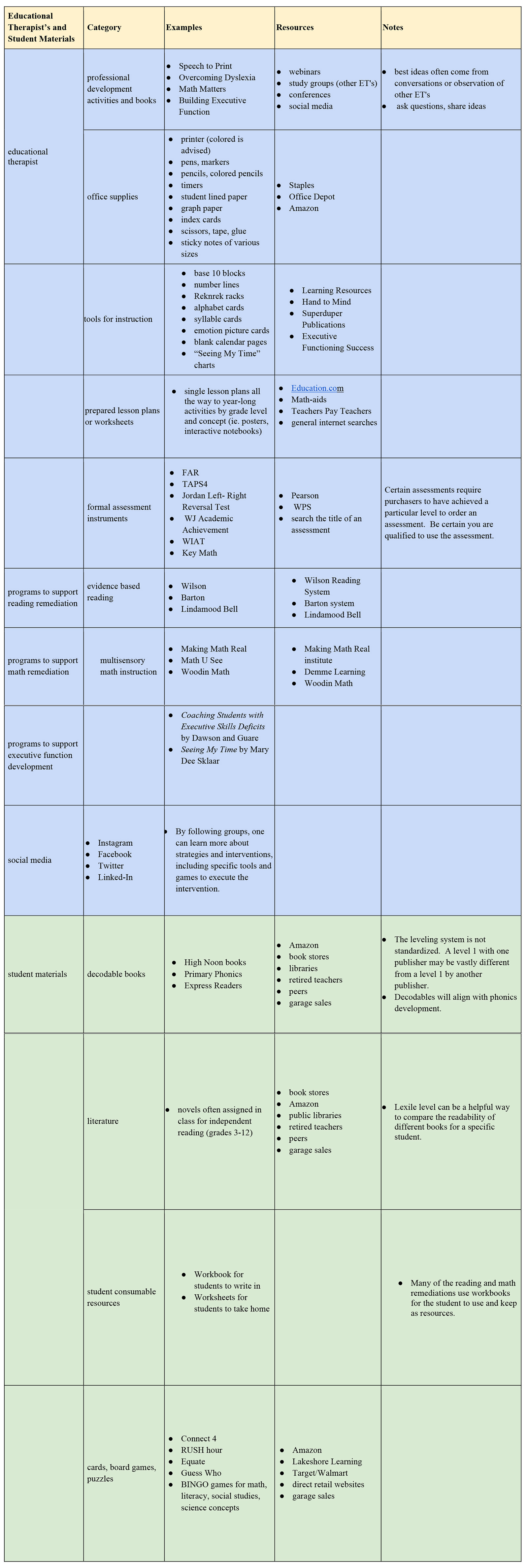
![[banner]-conference 2025](/images/promotions/promotion-26-conference.jpg)
![[sponsor logo]](/images/conference/sponsor-logos/APA-thumb.jpg)
![[sponsor logo]](/images/conference/sponsor-logos/NotreDame.jpg)
![[sponsor logo]](/images/conference/sponsor-logos/ucsc-logo.jpg)
![[sponsor logo]](/images/conference/sponsor-logos/Kiwi-Write.jpg)
![[sponsor logo]](/images/conference/sponsor-logos/McLean.jpg)
![[sponsor logo]](/images/conference/sponsor-logos/Havit-thumb.jpg)
![[sponsor logo]](/images/conference/sponsor-logos/Winsten-Prep-School.jpg)
![[sponsor logo]](/images/conference/sponsor-logos/AnnKaganoff-thumb.jpg)