![[logo]-AET](/templates/common/images/template/aet-logo-top.png)
![[icon]](/templates/common/images/icons/search-icon.png) Search
Search


The start of private practice will require a sizable investment into materials for students. It is important to think through both the needs of your students as well as tools the educational therapist will need to implement when working with the client. It is important to be selective but ensure you have the proper tools. It is easy to overspend, especially when you first begin. Think about the budget and specialization of your practice, both by grade level and content. Younger students typically do better with hands-on materials when learning new tasks while older students may require technology and digital materials.
A good place to start is to think of classroom materials needed for the various grade levels to help anticipate what may be needed. If you plan to see clients virtually, your materials will all need to accommodate that presentation mode. If you are seeing clients in person, a variety of school supplies should be readily available such as pencils, pens, highlighters, markers, ruler, protractor, scissors, stapler, hole puncher, binder rings, stapler, paper clips, etc. A white board and markers can be very useful and can save on consumable paper materials. A color printer is helpful for printing resources as well as for older students to print finished work. If seeing clients in person, furniture and décor for the space may be needed and should be included in the start-up budget. If you choose to work virtually, a budget for furniture and decor may be replaced by docu-cameras or other tools to support online instruction.
Outside of classroom/office supplies and furniture, the other resources will be dictated by the specialty of the ET. If you plan to specialize in literacy, your materials will differ than if you chose to focus on math. Most ET’s who work with literacy skills require reference materials such as dictionaries, encyclopedias, and atlases. Many of these can now be found online; however, it would be valuable to have a selection of favorite resource sites bookmarked on the computer to ensure quick and easy implementation during a session. This is a good practice when first starting as well as a good lesson to teach a student. Some ETs prefer to have paper copies of these reference materials for use in sessions.
Depending on the age level of the students you plan to see, a personal library of fiction, non-fiction, and poetry books at different reading levels will be required. A good selection of topics and reading levels is essential, from picture books, decodables (books written to give practice decoding specific word types like silent-e words or vowel team words), chapter books, graphic novels, Newberry winners to the classics. It is best to become familiar with the books that are typically assigned by the local school district or the individual schools. Many middle and high school students use online textbooks and are provided Chromebooks or laptops to access school materials. As a result, it is not essential to have a library of textbooks for the upper grade levels. There are sites such as STUDY.COM and LitCharts that require annual subscriptions but can cut down on the amount of material to have physically on hand. Mathematics will require resources and games that align with the content being covered in school by your clients or by the area of focus. There are numerous sites–some free and some requiring subscriptions–that can provide additional practice and strategies to assist in all areas of mathematics.
There are numerous choices for instructional materials and new materials are continuously coming on the market. Be thoughtful in your choices. Storage (either physical and/or virtual) and cost are two important factors to consider. If interested in a packaged program, spend time researching the various components to evaluate the use and how it could apply in your practice. Become familiar with the well-recognized companies who provide high quality educational materials such as EPS, Curriculum Associates, and LinguiSystems. Many companies offer training that accompany products, and some, such as Making Math Real, Wilson, and Lindamood-Bell, require training and/or particular credentials to purchase and implement materials with students.
Depending on the age and focus of your practice, many educational therapists purchase educational games and activities. Amazon, Lakeshore Learning, Learning Resources, School Specialty, and Hand to Mind have numerous resources to choose from. ThinkFun, Gamewright, and Learning Resources generate popular and educational games. Look for the award winners–voted popular by parents and teachers.
Gradually your library of materials will grow as it continues to align with the changing needs of the clients within your practice. Webinars, study groups, or social media can be helpful to identify new and creative materials for your clients. Quality of material is far more valuable than quantity. The table below lists types of materials to consider. Remember that you don’t have to buy everything in your first year of practice. Some materials are updated regularly, so you will have the most current materials if you get them as you are going to begin using them.
Practice Materials Table
Materials that are needed for your practice will vary among the types of practice, age group, and current financial situation. One way to approach this topic, is to divide it between supplies for the educational therapist and supplies for the students. Supplies for the therapist will include school supplies as well as professional development tools such as books, webinars, and courses. Materials for the student will need to vary to fit the group of students you are working with. Entire programs are available as are formal testing materials. Purchases of these larger materials may need to be spread out over time. It is best to examine the type of students you want to work with and who you are currently working with when making material purchases. A budget will help keep spending in check as it is easy to buy more than is needed. Games and materials will get dated, and everything does not have to be purchased in order to get started. Allow time for your tool box to grow with you.
Click on the table to open a PDF version. 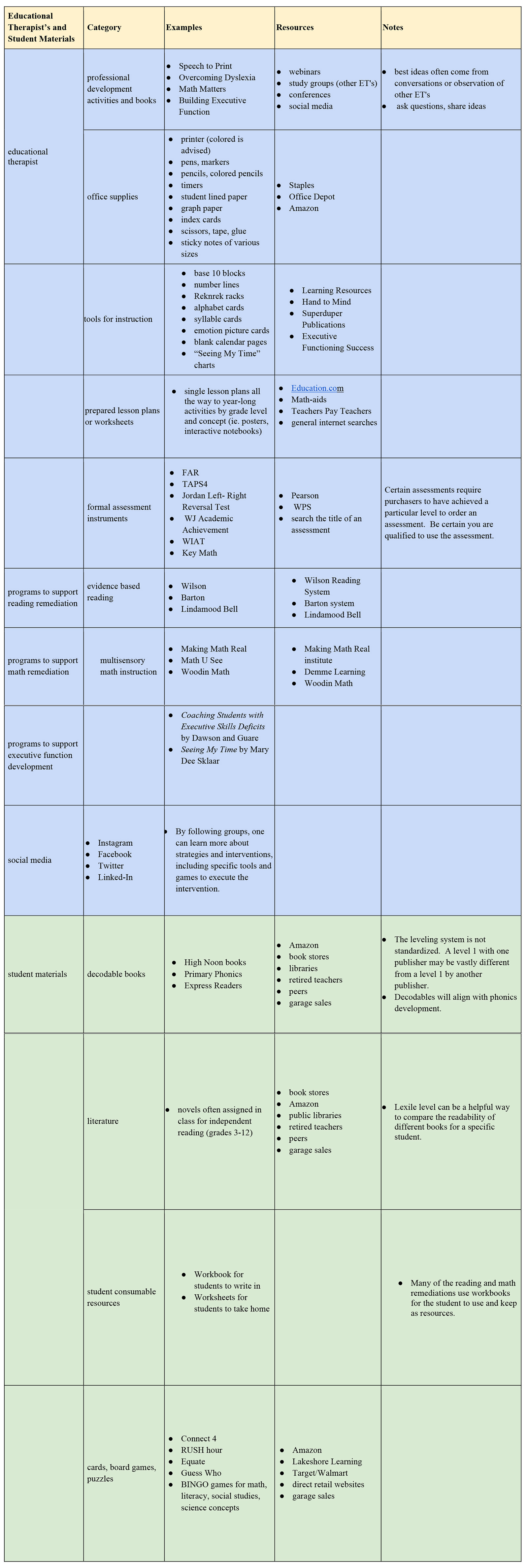
![[banner]-conference 2025](/images/promotions/promotion-26-conference.jpg)
![[sponsor logo]](/images/conference/sponsor-logos/APA-thumb.jpg)
![[sponsor logo]](/images/conference/sponsor-logos/NotreDame.jpg)
![[sponsor logo]](/images/conference/sponsor-logos/ucsc-logo.jpg)
![[sponsor logo]](/images/conference/sponsor-logos/Kiwi-Write.jpg)
![[sponsor logo]](/images/conference/sponsor-logos/McLean.jpg)
![[sponsor logo]](/images/conference/sponsor-logos/Havit-thumb.jpg)
![[sponsor logo]](/images/conference/sponsor-logos/Winsten-Prep-School.jpg)
![[sponsor logo]](/images/conference/sponsor-logos/AnnKaganoff-thumb.jpg)